Sermon: The Stories We Don’t Tell
Preached at South Jacksonville Presbyterian Church
June 21, 2020 – Father’s Day, Juneteenth Weekend
I began attending South Jacksonville while in college around 2004, and was the youth minister from 2005-2014. Both of my kids were baptized in this church. I figured, if I’m going to cash in 16 years of credibility, it’d be to take on white supremacy (in me and in the church) and support the movement for Black Lives in our time and in our own community. I offer this halting, imperfect attempt in humility. The work begins in my own heart.
Scripture: Matthew 10:34-39, Genesis 21:8-21
It’s so good to be with you this morning. For many of us, this is a reunion and for those who I am meeting for the first time, I wish we could do so without the limits of pandemic precautions. But we do these as concrete acts of love for each other and our neighbors. I pray for health and security for each of your families in this strange time.
I also want to wish a happy Father’s Day to those who are celebrating. And for those of you for whom this is a hard day, my heart and prayers are with you.
As much as we might want days like this to be easy and celebratory, life just isn’t always that neat with family. And this is what Jesus tells us in our very un-Father’s day friendly Gospel reading from the lectionary today: “Do not think that I have come to bring peace to the earth; I have not come to bring peace, but a sword. For I have come to set a man against his father, and a daughter against her mother, and a daughter-in-law against her mother-in-law; and one’s foes will be members of one’s own household.” Man against father, daughter against mother, family against family. Jesus is not teaching a Hallmark holiday.
Our reading from Genesis is not so Hallmark either. It’s Father Abraham, who had many sons, and many sons had Father Abraham. But instead of an edifying example of fatherhood, we see him and his wife Sarah jealous of the woman Hagar whom they have enslaved, and whose body they violated to produce a child and heir they no longer want, and they cast her and the child out into the desert to die. Now, granted Abraham does this with God’s approval; but this is one of those stories that sounds more like us justifying our terrible treatment of others by claiming it is God’s will than it does the compassionate God who loves justice and righteousness.
Because it’s hard to see any goodness in what happens next. Hagar runs out of food and water, and as she and her son Ishmael succumb to thirst and hunger, abandoned, cast out, she lays him on the ground, forced to watch her son die. It is hard to imagine a God who would want this, for a mother, for a family, to be driven to this desperation, to this suffering. Dying. Watching as a loved one dies on the ground. This is not the edifying story of our fathers. This is not the story we tell.
Our sermon title today is, The Stories We Don’t Tell. This sermon is some ways a lament and in some ways a confession. As I thought about these passages, I was drawn to the issues of racial justice prominently for the last couple months, but really we know for years, decades, hundreds of years, since the founding of this nation. And I thought I’d get us to lean into discomfort in this sermon. So I’m just giving you a disclaimer now, that’s what we’re going to do. It’s discomfort for me too.
George Floyd was 46 when he was killed. He was a father and grandfather. Police Officer Chauvin kneeled on Floyd’s neck for 8 minutes and 46 seconds, murdering him, while three other police officers watched. And it’s all on video. For his family, for his daughter, and someday for his young grandchildren to watch him die on the ground.
My heart has been heavy for George, for Breonna Taylor, shot dead in her hallway by police officers firing wildly, for Ahmaud Arbery, out for a run and hunted by two white men who had been unofficially deputized by local police officers to look out for the neighborhood.
I know that you lament with me for these lives unjustly taken. We know God our heavenly parent, like a father, like a mother, is angered and grieved for George, Breonna, Ahmaud and so many others.
But I also know we don’t all agree about how to view these things. We disagree about polices and protests. I hear people say “This was terrible and those guys were racist, but….” Or others say, “Those were just some bad apples.” We distance ourselves, we say, those are the exceptions, they’re isolated incidents. And when I say “we”, I mean, mostly white folks, like me and many of you.
But that’s largely not the discussion I’ve heard in my study of Black American history and religion. Its not the discussion in Black communities, in Black churches, in Black history. They’ve been crying out, from enslavement to this day. From Frederick Douglass and Sojourner Truth who stood against the slavery as a system justified as Christian by white slaveholders, to Ida B. Wells and Martin Luther King Jr. who fought lynching and Jim Crow, to James Baldwin and Marsha Johnson who led movement for LGBT justice, to the founders of the Black Lives Matter movement, Patrisse Cullors, Opal Tometi, and Alicia Garza.
These voices through the ages, and speaking around us in our own city, our own churches and workplaces and families, say that these are not isolated incidents. I think part of the difference is about the stories we tell and the stories we don’t tell.
In the predominantly white church, that’s us, not all of us here are white, but this is a predominantly white institution. The way that we have told stories about white terror and white supremacy have distanced us and put it in the past. Its the edges, the extremes, its the KKK. Its those examples that, we want to believe, have nothing to do with us.
And it is true that this church and many of you have been involved with causes for racial justice. I was encouraged to see a message in your weekly newsletter that came out this week using the Confession of 1967 from our Presbyterian Book of Confessions, addressing racial injustice. I’ve been with many of you at ICARE rallies where we stood for issues of racial injustice in the city.
But one of the things I have had to learn about the story I tell is that, it’s easy for me to tell the story that me and my family are the heroes of this thing. It’s harder to say, maybe me as a white person, even as I’ve tried to be a good ally and advocate and accomplice for racial justice, maybe I have been shaped by white supremacy. Maybe our church has been.
And that indeed is what we have heard from Black theologians and abolitionists through the ages. So I want to tell some of their stories today, so that you can hear this alternative story that we don’t always tell in our white churches.
We don’t tell the story that Frederick Douglass, like Ishmael, was born of an enslaved woman and her enslaver. One of them at least. Douglass never knew exactly who his father was, which member of the slaveholding family had violated his mother. But he knew this much: the man who owned him and lashed his back as a child, was a devout, church-going Christian. Yet Douglass found freedom in the gospel, indeed, it spurred him to escape captivity. He said, “I love the pure, peaceable, and impartial Christianity of Christ; I therefore hate the corrupt, slaveholding, women-whipping, cradle-plundering, partial, and hypocritical Christianity of this land. Indeed, I can see no reason, but the most deceitful one, for calling the religion of this land Christianity.”
Now this can seem a long time ago, to the white church at least, and it can seem like that slaveholding Christianity is an abomination with nothing to do with us. But another part of the story that we don’t tell is that the Southern Presbyterian church broke off from the Northern church to support slavery. Its theologians and preachers quoted scripture to support enslavement, including a founding President, James Henley Thornwell, of Columbia Theological Seminary, where many of our Presbyterian pastors are trained today. And they do make them read those justifications, so they can learn to be honest about our Presbyterian family history we don’t like to tell.
But maybe that all seems distant. Let’s bring it a bit closer.
After the Civil War, and freedom for enslaved Black Americans, there was a period known as Reconstruction and a brief flourishing of free black communities, progress soon enough sabotaged by regressive factions in the South, and leading to the beginning of the lynching and Jim Crow era. Lynchings were killings of black people by white people and even mobs, meant as racial terror, to inflict fear and compliance. There around 7 in Northeast Florida, and over 4000 from 1880s to 1960s.
I want to stop there for a moment. Think about, when we see these incidents in the news and we think they are isolated incidents. But if we don’t have within our bodies and our families this history of racial terror. 4000 people from the 1880s to the 1960s. The 1960s. In some of our lifetimes. The memory is right there. You can see how, for those of who are less connected to this family history, because we come from white heritage, it may look very different to us than it does to our Black neighbors. When they see George and Ahmaud and Breonna taken.
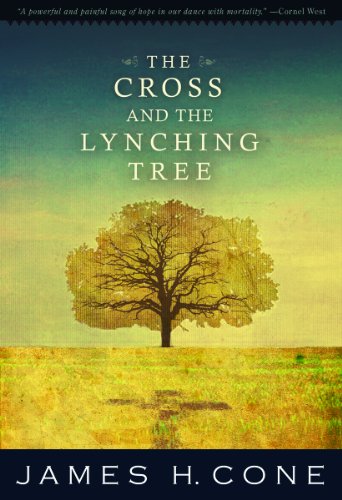
Black theologian James Cone wrote the seminal Christian text on these atrocities, the Cross and the Lynching Tree. He sees in Jesus’ unjust suffering on the cross the suffering and lynching of Black people. He tells one story from 1918, in Valdosta, Georgia. The imagery is too graphic. A pregnant mother, Mary Turner, objecting to her husband being lynch, and they became victims themselves.
James Cone said this about the Lynching Tree, that “it is a metaphor for white America’s crucifixion of black people. It is the window that best reveals the religious meaning of the cross in our land. In this sense, black people are Christ figures, not because they want to suffer but because they have no choice. Just as Jesus had no choice in his journey to Calvary, so black people had no choice about being lynched. The evil forces of the Roman state and of white supremacy in America willed it. Yet, God took the evil of the cross and the lynching tree and transformed them both into the triumphant beauty of the divine. If America has the courage to confront the great sin and ongoing legacy of white supremacy with repentance and reparation, there is hope “beyond tragedy”.”
Repentance and reparation. That would mean we who are white would have to admit we are a part of white supremacy. I would have to let go of the idea I am the good guy. I would have to confess that and untangle the parts of my life caught up with systems of white supremacy. I have decided this is what I will do.
What I have heard from my black friends and colleagues is that they will go on living and thriving. I was honored to celebrate Juneteenth with friends last week, commemorating the day, June 19, 1865, when word reached the last enslaved Black Americans in Texas, of the freedom granted them 2 and half years earlier by the Emancipation Proclamation. It’s a reminder of justice delayed and a celebration that freedom will finally not be denied. And we sang Lift Ev’ry Voice and Sing, written by Jacksonville’s own James Weldon Johnson and John Rosamond Johnson, which we will sing at the end of this service.
A group of 700 Black Theologians commemorated the day with a theological confession of resistance that begins with just such a sentiment:
“On the occasion of this 155th observance of Juneteenth, the jubilant celebration marking the end of American chattel slavery, we, a collective of interdenominational Black pastors and theologians representing the prophetic tradition of Black churches in the United States of America, lift our voices to emphatically repudiate the evil beast of white racism, white supremacy, white superiority and its concomitant and abiding anti-Black violence.
Although we have been temporarily severed from our respective chancels due to the global effects of the COVID-19 pandemic, the doors of the Black Church are still open as we congregate on one accord in the Spirit and by the power of a God of freedom, justice, and love, who was with us in the beginning (Jn.1:1) and has brought us this far by faith.”
https://www.colorlines.com/articles/theological-statement-black-church-juneteenth
Black communities will keep the faith and keep on calling for justice whether we join them or not. But we should join them.
And while some black folks grow weary and doubtful that white folks will step up, others still wait, as did Martin Luther King Jr., when he waited for white churches and white moderates to stand against racial injustice.
There are so many waiting.
They’re Rodney Hurst and Alton Yates, waiting for us on August 27 in Hemming Park, where in 1960 they were beaten by white men with Ax Handles on a Saturday because they dared to sit-in for equality at the W.T. Grant Department Store lunch counter.
They’re black students at Bishop Kenny, Episcopal, and Bolles, who started social media accounts last week chronicling their far too many experiences of racism at those schools.
They’re the residents of Northwest Jacksonville and other black neighborhoods that were made promises at the consolidation of this city in 1968 that have never been fulfilled.
They’re black members of this church and our denomination, from these pews to Woodlawn Presbyterian Church across town, and our newly elected Co-Moderator of the General Assembly, Gregory Bentley of Alabama. He was elected last night, along with Elona Street-Stewart, who is the first indigenous woman to be Co-Moderator. That’s not a story we’ve told before.
I submit you: may we be shaped as never before by stories we didn’t tell, the stories of our Black theologians and preachers, friends and neighbors. May we listen to them and learn. May those of who are white have the courage to confess and repent of the white supremacy that has shaped us, and may the whole church come together in the anti-racist gospel of Jesus Christ. That would be good news.
And thank you for going with me on this journey of discomfort.
 Matt Hartley