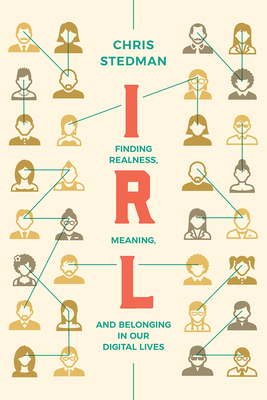
My friend Chris Stedman wrote a new book, “IRL: Finding Realness, Meaning, and Belonging in Our Digital Lives, which you can order from any store, online or off, but I always recommend a local bookstore; here’s my local store, and you can order online from anywhere for delivery: https://www.sanmarcobooksandmore.com/book/9781506463513
My review:
As I started Chris Stedman’s new book on realness in our digital lives, the old Hair Club for Men commercial came to mind: “I’m not only the Hair Club President; I’m also a client.” The President would then pick up a blown-up picture of his previously balding head, as if to say, “I’m the real thing.”
Well, Chris seemed the perfect person to write this book and I the perfect person to read it, as we both could hoist blown-up pictures of our tweets and confess, “I’m not just Very Online President; I’m also a Client.”
In “IRL: Finding Realness, Meaning, and Belonging in our Digital Lives”, Chris explores that fraught, problematic, but also joy filled relationship many of us have with social media and online lives. His question is not whether online life is real but how.
His first drag show sets the stage: “There was a magic in the messiness of amateur night, its combination of audacity and naked vulnerability…The realness of drag is that it heightens, dramatizes and deviates in order to reveal.” Our digital lives, he argues, can operate in this reflective mode, helping us question what we have been handed, both online and offline molds which have not served us or told the truth. I thought of moments in my own life when, rather than posting another joke, or smiling face, I exposed the sharp edges of heartbreak during my divorce. And with no shame, I think of a thirst trap posted early last year from a gym bathroom which dramatized and deviated from my usual landscapes, Serious Matters, or family portraits to say: if I am asking for your attention, I may as well draw your attention to my attractiveness and singleness (life update: thirst trapped).
Chris engenders trust as searches for Online realness by confessing the limits and weaknesses of social media. He acknowledges correlations between depression and social media use, the loss of institutional benefits of community and accountability, and the need to hold things not in the light but privately for us alone. I’m reminded of Mary, the Mother of Jesus, who had a habit of turning inward to treasure memories of her son in her heart. Some things are just for us. But Chris also wisely notes the faultiness of memory and the possibility of social media to keep some memories and feelings and learnings more firmly held in our digital scrapbook. And there is the bigger story we can reach through the internet, the constellations we can find ourselves a part of: “I can build a story out of distant stars–finding my place in a larger narrative, connected to things beyond myself.”
I’ve felt a kinship for Chris since we met several years ago, and as we stayed connected especially via Twitter. Perhaps it’s a fellow mild midwestern kid vibe (small town Indiana for my earliest memories). Or perhaps I knew another Geography Bee Champ when I saw one, a distinction he reveals in his chapter on Mapping the Territory (a chapter which triggered me to mutter, “Ya gotta know the territory…” of the great midwestern show, The Music Man.) For Chris, the new online territory he mapped in his youth liberated him: “As a closeted adolescent I used the internet to create spaces where I could be myself, fully, for the first time.” This is a prominent and important theme throughout-despite its pitfalls, the internet has given new voice and platform to those who have never actually been voiceless: ‘Marginalized communities are more able than ever before to map their lives online and document the things people in power wish to deny or erase.” This is a world changing movement of humans committed to collective liberation, bringing along White cis-hetero Christian guys like myself who are lucky enough to learn from these lights.
On the other hand, the internet and social media is not without its structural inequalities. Early on, Chris notes the obvious problems of how social media has its own corporate overlords, with their own profit-based motives, which of course contributed to electoral and thus policy disaster for marginalized people. And some of those folks are not in fact online at all: “Frequent social media use can put distance between the most online among us and an accurate perception of the world…the poorest, most marginalized, and least educated people…are also the least represented online.” Chris saw his own home state of Minnesota seemingly misunderstood at a distance by elite NYC media, and I have similarly felt at times that Jacksonville, Florida only seems understood on election cycles. But local twitter is a thing too, and that I think creates some opportunity to get closer to the truth. Jacksonville Twitter has become a foghorn for local journalists, amplified by locals, exposing corruption and lifting up the cause of equity. Jacksonville Twitter: I love you and how well you know your place.
The critique of online life I most resonated with, from experience, is its habit forming invasion of every space of life: “Without transformation, the system as it exists can play to some our worst instincts–including our aversion to boredom…In my preinternet life, whenever I felt bored, I was forced to brainstorm solutions: to try things I might not have otherwise tried, read things I might not have otherwise read, explore places I might not have otherwise checked out, and discover things I might not have otherwise noticed.” I have felt this invasion acutely over the years and recently, and have struggled to determine how to keep what I love about my online life while not keeping my phone as an added body appendage and scrolling as 24/7 tic. I spent the month of October reading Chris’s book, deleting and reloading my social media apps (mostly out of necessity – but that’s not all I used them for). As Chris says, we are ultimately amateurs, figuring this out together.
I’m grateful to have Chris as a guide in this search for meaning, belonging, and realness online, and if you are looking, I recommend you read IRL. His closing pitch is a habit we could all benefit from, based on a rabbit many of us know and love: “Cultivating a velveteen habit in our digital lives–a practice of paying attention, taking perspective, and treating our relationships and behaviors as real and consequential–requires a level of honesty with ourselves about our actions, motivations, and memories.” Life online can be real and good and developed into a rich fabric with offline life. A worthy challenge for a digital age.
 Matt Hartley