Sermon: When Doubt is in Our Bones
Preached April 24, 2022 at Riverside United Church of Christ
Scripture: John 20:19-30
Doubting Thomas
It’s been…one week since Jesus looked at us, resurrected. And in our scripture reading today, we move from that Easter day to one week later. In doing so, we meet Thomas. Or as he is famously, historically known, based on this passage, Doubting Thomas. Now, this isn’t the only thing Thomas is historically known for. In fact in India, he is widely credited as bringing the good news of Jesus Christ to that land, and one of its historic churches is known as the Mar Thoma Church, the church of St. Thomas.
So the one who doubted became the one who shared Christ’s love far and wide. That’s both encouraging and intimidating. Having a global impact may be a bit hard for us to visualize for ourselves. I think most of the time we probably find ourselves like Thomas in that one week after Easter.
See, Easter Day, for Thomas, was a day of doubt.
It wasn’t lilies and big hats and egg hunts and Christ the Lord Has Risen Today, Alleluia. It was another day of grief, that by the end of it turned to confusion, denial, and doubt. And not just a day, but a week.
See, Mary found the empty grave, and though Peter and John came to see the empty grave, it was Mary who met the resurrected Jesus and carried word to the disciples. They seem to have had their own doubts, because later that evening, they were locked in their house, hiding for fear they would follow Jesus’ fate. And this was when Jesus appeared to them.
But Thomas missed it. Where was he, I wonder? Why was everyone else there but not him?
Was he out for a walk? I mean, regardless, bad timing.
He arrives later at the house, perhaps even later that night, after Jesus has gone. The disciples tell him, but like Mary, like the other disciples, he wants to see Jesus. How can he believe without seeing after what he has seen? How can he work through this, when his whole body has been consumed by trauma, loss, and grief, when doubt is in in our bones? And what do we do when doubt is in our bones? These are our questions for today.
Faith and Doubt
It might help by defining just what we mean by doubt. It’s a word that has plenty of pedestrian use. If you asked my kids, can Dad go a week without having hot fries and red bull? They might say, I doubt it. Or if we leave our leftover candy out, will Dad be able to resist eating it? Again, doubtful.
Or in a legal setting, there may be reasonable doubt. And here doubt is good, it helps guard against convicting the innocent.
But if you grew up around church, if you’re here in church now, when we hear the word doubt, we probably most often think of it in the faith context. Faith and Doubt.
There are more churches now that will tell you doubt is ok and even a good thing. But many of us came up understanding doubt to be a bad thing. Doubt was stigmatized.
And it was simplistic. A multiple choice test. True or False. Yes or No. Scantron Christianity.
This elementary understanding passed on to us is that doubt just means not believing things about faith. Or not believing that the religion itself, at its core, is true. So doubt might mean doubting the existence of God or as in our passage today, the resurrection of Jesus. True or False? Doubt or unbelief?
This, Greek scholars tell us, is what the word in our passage today, rendered as doubt, means: unbelief. Thomas moves from belief to unbelief.
But what is belief actually? In their book, Living the Questions, David Felten and Jeff Procter-Murphy share this insight: “The Greek and Latin roots of the word ‘believe’ mean ‘to give one’s heart to.’ Believing isn’t necessarily limited to giving one’s mental assent. It’s suggests something deeper-something that asks for our whole selves”.
So in belief, in faith, and in doubt too, our whole selves are invested. Our bodies too.
Doubt in his Bones
So doubt is not just a head game – doubt gets in our bones. And the body keeps the score. That’s the title of a well known book by Bessel Van Der Kolk, about trauma. And though doubt may not always be a matter of trauma, it certainly is sometimes, and it is here for Thomas and the disciples.
Let’s imagine for a moment what it was like for Thomas to have this doubt in his bones, in his body. For it not to be just a head game. It wasn’t doubt about 2000 years of church teaching. It maybe wasn’t even much about religion or faith at all. It was about life. The life he had led and lost when Jesus was crucified. The life of his people, the Jewish people, occupied and repeatedly crushed under Roman rule, divided among themselves about how best to survive and move forward. Jesus spoke hope into Thomas’ life, and here we can only speculate, but we know what it’s like to be human. Before Jesus was crucified, before Thomas joined this ragtag crew, he may have suffered the same kinds of grief and loss and pain we all do. Especially as a subjugated citizen of an occupied land, we can imagine how much injustice, lack of basic needs, and violence may have been worked into Thomas’s bones. A body that may have carried exhaustion and stress, constantly on guard and tense.
And then came Jesus. His beloved teacher. His lord. A direct connection to the God of hope and justice. Now imagine how that felt in his body. The loosening of tension. Deep breaths and sighs of relief. The cooling touch on hot wounds. And not just a moment of that, but a year, two years, maybe three years of healing. Seeing Jesus heal others. Hearing his words of comfort and his energizing words against the deadly powers. Surrounded by friends. A community of healing and hope. Tending to the trauma of their disjointed lives.
And then. The Romans crucified Jesus. And imagine how it all came rushing back. Grief, trauma, despair, flooding back over all that hope. The shattering loss of their friend and teacher, and of the hope this vision and community gave them. And the fear that they may be next. That’s the doubt, all of that Life itself in doubt.
That being said, I do want to give some credit though to the head game of doubt. The thoughts we think happen in a body and affect them. It’s not disconnected from our bodies, but it can be very in our heads. And lonely. It can be a deeply introspective and even agonizing and isolating experience. We may think we are alone and can turn to no one for fear of being rejected or put down. This is worse in traditions where doubt is stigmatized. I remember being a college student with doubts, in a campus ministry where I knew my doubts were incomprehensible or a threat to others. Eventually, even those I trusted had their lines I crossed. There is a reason doubt is sometimes characterized as a dark night of the soul. And with it exhaustion, tension, sleepless nights.
This was maybe what Thomas’s week after Easter was like. Some of us have gone through much longer.
Doubt is embodied. The head game is always in our body. And its about safety in relationships and community. It’s about our hope for the world or lack thereof. Doubt is about life itself.
Doubting Life Itself
What was at stake for Thomas in the crucifixion and in the resurrection was the life he had, and his hope in the world. The world he had a hope for. What does life mean when death and injustice reign? These have been hard questions for me in recent years. From the spike in Christian nationalism here in the U.S. to supremacies all around the world, and its in roads in our own state and through the complete failure of our nation to love our neighbors through Covid, leading to nearly a million deaths and many more disabled and tramautized by loss. Friends, I have such doubts. I still believe in the love of Christ, but does it make any difference? What do we do now?
The Table at the End of the World
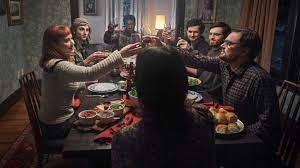
A new movie recently swooped into these thoughts for me. It made me laugh too, which is nice when the topic is so heavy! Don’t Look Up, which you can find on Netflix, tells the story of a Comet on a crash course with Earth, and the earnest scientists and NASA officials trying to convince someone to do something about it. It’s a fable about global warming and probably about Covid as well. The scientists warnings fall on deaf ears to self interested politicians and shallow media, which leads one of them to scream on air “We are all 100% going to die”. It’s funny and sad.
As the movie comes to end, some of these who gave every effort, gather together in a house, locked away from the world, from the chaos of a moment before the comet hits earth. They gather around a table, a table at the end of the world. A table of grief and fear. And yet also, somehow, a table of tenderness, of hope, of friendship, of new understanding. The table asks a young man who they know to be religious, in his own way, to lead a prayer.
“Almighty Creator, we ask for your grace tonight, despite our pride, your forgiveness, despite our doubt. Most of all, Lord, we ask for your love to soothe us through these dark times. May we face whatever is to come in your divine will with courage and open hearts of acceptance.”
Leonardo Dicaprio’s scientist who fought so hard to save the Earth follows this by saying, “We really had it all.”
And he knew, because he had left that table, he had left is family, for fame, for an affair, but when it came down to it, he knew where to go, he returns home. He returns to the table. Where friendship and family meet. Where they see the world clearly, not without fear, but together.
It’s been one week – Returning to the Room
And so it was with the disciples, who it looks like returned on Easter evening to the same room where they shared their last supper with Jesus.
Diana Butler Bass noticed this and shared it in her recent post, The Holy Thursday Revolution:
““The house where the disciples had met” leaped from the page. What house? Of course! The house where, just a few days before they’d had the Passover meal. The house where Jesus had washed their feet and called them his friends. Where they had shared bread and wine — the house of the ‘upper room.'”
In their fear, they returned to the place of love, hope, and healing. And Jesus appeared to them. And while Thomas missed that moment, he too returned to the room. And after a week of doubt he returned again. And he saw Jesus too. In the flesh. In his flesh. In his bones.
Keep showing up
This is the power of the disciples, and the power of Thomas, in Christ. They keep returning to the house, to the table at the end of the world, the table that Jesus set, even with doubt in their bones. They took their doubt there. Just as doubt is in the body, so is the answer. The answer is not certainty. The answer is showing up. Show up together as the church. Show up with your family, chosen or biological. Show up to the table with friends. Show up for yourself, in self care and prayer and a walk in nature or therapy. When doubt is in our bones, may we go to places of love, hope, and healing, and in our experience, as a mystery, we may just meet the resurrected Christ.
 Matt Hartley