Sermon: Uncommon Friendship
A Sermon at The Well at Springfield
May 8, 2022
Scripture: Ruth 1:1-18
Our topic today is Uncommon Friendship. I am thinking particularly of friendships across social identities, such as race, religion, and gender and sexual identity. My theological principle is this: diversity is sacred. But diversity going well is not a given, so what we do with it matters.
I was thinking about that this week when my daughter reminded me of a favorite essay. My daughter has decided she is a writer and I’m very proud. She likes to write poetry and she won an award this year. She’s here with us this morning, so I get to join the proud tradition of preacher Dads preaching about their kids in their presence. Like my father before me.
Now, I’m proud in part because I was and am a bit of a writer myself. I dabble more in prose, and mentioned to her that I took a college course on creative non-fiction. She wasn’t sure what this was, so I said, you know, like creative essays. Now this really confused her. Creative essays? Is that a thing? Not just 5 paragraphs and mind numbingly boring for a standardized test? She was well and truly shocked.
So I introduced her to one of the great essayists and humorists of recent years, David Sedaris. You may have read some of his essays and books, and we dove into perhaps his most popular work, Me Talk Pretty One Day. The title refers to his halting attempts to learn French with other non-native speakers in France. In one class, they begin talking about Easter and things go awry. He writes:
“The Italian nanny was attempting to answer the question when the Moroccan student interrupted, shouting, “Excuse me, but what’s an Easter?”
Despite her having grown up in a Muslim country, it seemed she might have heard it mentioned once or twice, but no. “I mean it,” she said. “I have no idea what you people are talking about.”
The teacher then called upon the rest of us to explain.
The Poles led the charge to the best of their ability. “It is,” said one, “a party for the little boy of God who call his self Jesus and . . . oh, no.”
She faltered, and her fellow countryman came to her aid.
“He call his self Jesus, and then he be die one day on two . . . morsels of . . . lumber.”
Sedaris goes on; this is the problem, he says:
“It had to do with grammar. Simple nouns such as cross and resurrection were beyond our grasp, let alone such complicated reflexive phrases as “To give of yourself your only begotten son.” Faced with the challenge of explaining the cornerstone of Christianity, we did what any self-respecting group of people might do. We talked about food instead.
“Easter is a party for to eat of the lamb,” the Italian nanny explained. “One, too, may eat of the chocolate.”
“And who brings the chocolate?” the teacher asked.
I knew the word, and so I raised my hand, saying, “The Rabbit of Easter. He bring of the chocolate.”
…
“A rabbit?” The teacher, assuming I’d used the wrong word, positioned her index fingers on top of her head, wiggling them as though they were ears. “You mean one of these? A rabbit rabbit?”
“Well, sure,” I said. “He come in the night when one sleep on a bed. With a hand he have the basket and foods.”
The teacher sadly shook her head, as if this explained everything that was wrong with my country. “No, no,” she said. “Here in France the chocolate is brought by the big bell that flies in from Rome.”
I called for a time-out. “But how do the bell know where you live?”
“Well,” she said, “how does a rabbit?”
This is a masterclass in uncommon friendship. Bridging culture and religion, struggling together for common understanding. Generosity, teamwork. But also disagreement. Diversity can be encouraging and it can be confusing, as challenging as it is thrilling.
Our scripture reading today from the book of Ruth gives us a view of uncommon friendships. In a time of famine, an Israelite family moves to Moab. Here’s what you need to know about that: the Moabites were at one time regarded as Israel’s enemy. In fact, in Deuteronomy, the law says, never make up with the Moabites because they did not feed you when you were wandering. So where do Elimelech and Naomi the Israelites go when famine hits and their family needs to be fed? Moab. They are open to depending on the enemy. And it seems, despite the old divisive neighborly feud, they are fed. And not only that, but they find families who is willing to intermarry with them, their daughters Ruth and Orpah marrying Naomi’s sons. An ancient version of Interfaith families.
But these ripples of new life after escaping the famine are soon splashed away by the tragic death of the father, then both of the sons. Naomi and her daughter in laws are left alone. This is how Ruth’s story begins.
It feels like this is how many days begin for me recently. I can only speak for myself, but maybe you are feeling some of this. Still keeping an eye out from Covid, and hardly recovered from the grief of the pandemic. Weary from the news about Roe v. Wade, attacks by our state government on LGBTQ people and telling the truth about racism, are we headed for a civil war or societal collapse, worldwide religious and ethnic fascism, and global warming on top of all of this. And that’s just the stuff we can all see out there and around us. Then there’s the cracks in our own lives, the illnesses, family struggles, loss.
We are walking with some or much or all of that. As has been said, we live in unprecedented times and if only we could live in precedented times.
So this is where Ruth was too. But this is not where Ruth’s story ends. It is only the beginning. And the hinge is an uncommon friendship with Naomi, and through it an uncommon friendship with a God who was not even her own. These are the ripples of new life for Ruth.
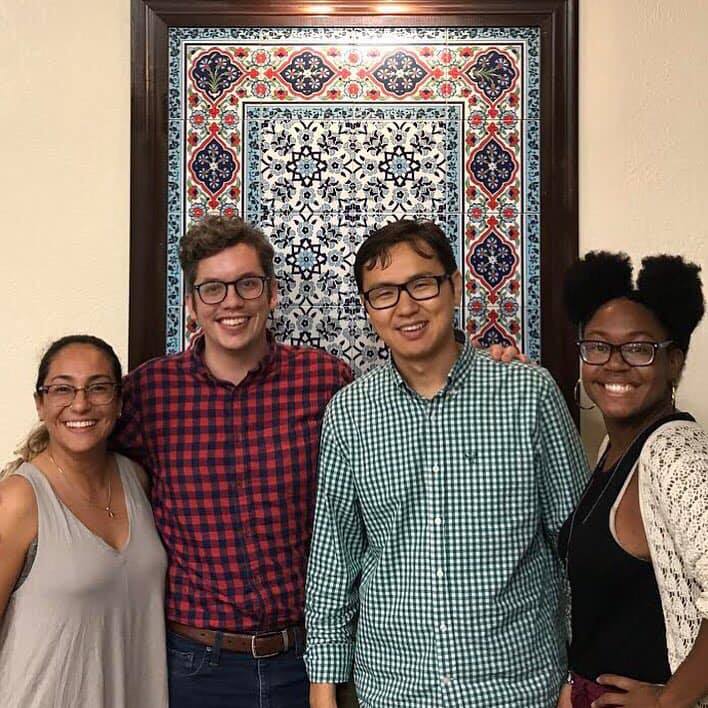
In my work at the UNF Interfaith Center, I am fortunate to see what uncommon friendship among students can look like as it unfolds and grows through mutual curiosity. Here is a recent scene:
We gathered after sunset, a mid-Spring eve, a week after Pesach and Easter, in the month of Ramadan. I looked around at a table of fifteen University students, mouths stuffed with food, noses sniffing the coffee being passed around as a gourmet experience, eyes alight with laughter. Some heads covered with scarves. One with a yarmulke. Skin along every shade of human. Cultures and nations and languages and religions and non-religious too, various sexual and gender identities, immigrant and native born. A table of joy and uncommon friendship.
Like the world after Babel, when biblical legend holds the heavenly host spun humans out into many cultures and languages. This ancient, jagged story found in the book of Genesis in the Hebrew Scriptures tells of gods fearful of humans seeking oneness through building a grand tower to heaven, and so they scatter them from one to many. Modern interpretations wonder if the story helps us see what Chimamanda Ngozi Adichie calls “the danger of a single story”. What if the divine will or the sacred that there should be divisions and tribes among us? What if diversity is sacred?
The revelation of the Qu’ran, in Surah Al-Hujurat, extends this logic, in a passage I have often heard quoted by Muslim friends: “Human beings, we created you all from a male and a female, and made you into nations and tribes so that you may know one another.” In this telling, difference certainly is sacred, and is no less than an impetus to seek each other with mutual curiosity.
Jesus, too, taught his followers to learn from neighbors who were unlike them. The famous parable of the Good Samaritan, often interpreted as a call to help those in need no matter what, in fact ends with Jesus imploring a fellow Jew and expert in the law to learn how to be a neighbor from one of “those people”, a Samaritan, who was the wrong kind of religious and ethnically impure. The point of the parable is not just to help but who to learn from: “Go and do likewise.” Be like a Samaritan.
Uncommon friendship far outdates humanity, of course. Biodiversity branched out exponentially from single cell to, for instance, trees. Trees have been at the work of cooperative diversity for a bit, according to Forest Ecologist Suzanne Simard, who “showed conclusively that different trees — and even different tree species — are involved in a constant exchange of resources and information via underground fungal networks”. She calls them social creatures and notes that birch and fir and ponderosa trees, among others, work together, with some trees “mothering” others, sharing resources in mutuality.
But mutuality and uncommon friendship has never been the whole story. Nature and humanity have conflictual and destructive diversity too. Trees will poison each other and starve saplings of light. Humans enact not just individual acts of violence against each other but whole systems of supremacy which harm anyone relegated to lower rungs of whichever caste system is in power. Supremacies weaponize our unlikeness, turning us against each other, convincing us we must change or defeat each other. Uncommon friendship is not our utopian past or future. It is always only something we can choose or not. Will we be the trees who share nutrients?
We can look to this ancient story of Ruth and her adopted family for some inspiration.
First, we see families who do not fear each other, though they have been cast as enemies by their culture. Hebrews and Moabites. How can we expand the cultural connection of our families? How can we honor our own Intercultural and Interfaith families?
Second, we see mutuality and trust. As Naomi returns to her land, she decides not to force this complete change, of culture and religion, on her daughter in laws. As my Muslim friends say, there can be no coercion in religion. In fact, Naomi recognizes how generously they have treated her family and gives them God’s blessing in choosing to stay. As Christians, we have often learned and insisted that others must change to receive God’s blessing. We look with supremacy at other religions and cultures. Maybe its time for us to be like Naomi, to recognize how we have been blessed by others unlike us and offer only blessing with no requirement. Kind of sounds like the gracious God we know in Jesus.
And finally, what about Ruth? She chooses to trust uncommon friendship. To follow uncommon friendship. To seek uncommon friendship, and live among it. And in that, she finds ripples of new life, a new family, and a relationship with God founded in uncommon friendship.
This gives me some hope. Times were hard for Ruth, and they are for us. We carry a lot. We can’t do it alone. Maybe there is a way forward in uncommon friendship. When we call diversity sacred. When we seek out our neighbors who are different with respect. When we establish new communities of mutual curiosity, mutual love, and mutual power. When we trust that God made us for this and makes ways of healing and new life for each of us AND the earth through uncommon friendship. Amen.
 Matt Hartley