Written for the Jax 100 Contest, commemorating 200 years of Jacksonville, Florida, and look forward to the next 100 years
July 10, 2022
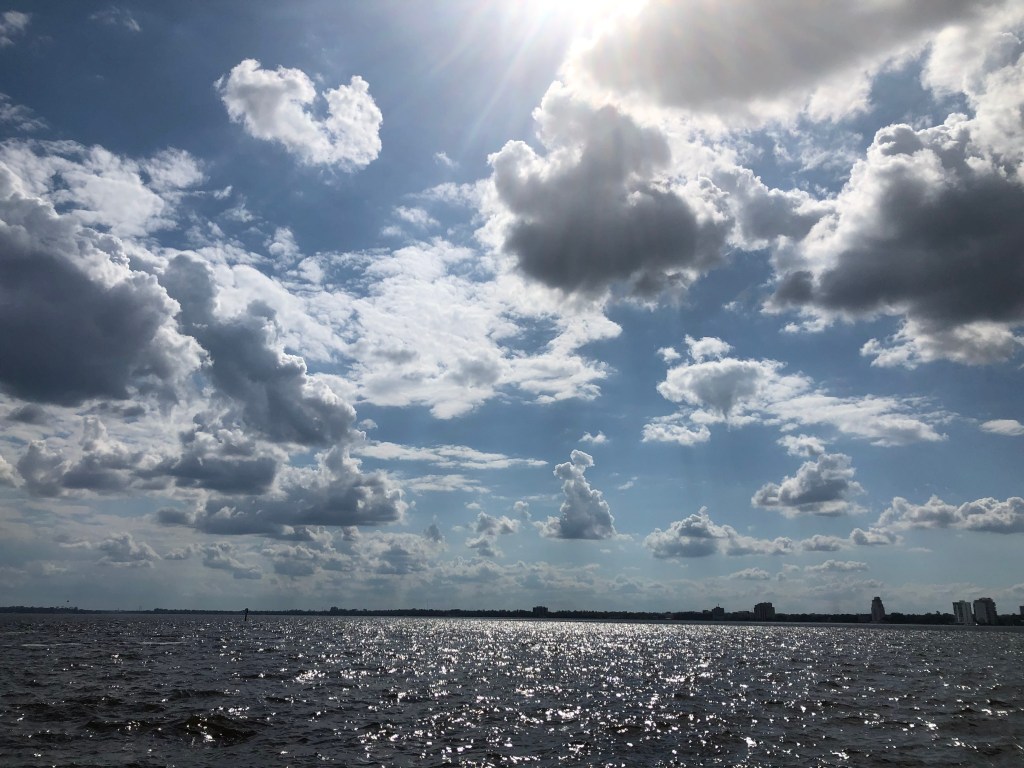
A river flows through the city, sparkling like crystal. For three hundred miles it has crawled north, lazily, as its history has crawled through time. The flow of a long history, the flow of the river to the city, sustaining diverse forms of life along these banks for 100,000 years.
When I was growing up near Cape Canaveral, the way to Orlando was Florida State Road 520 west, across a winding ribbon of river by the Lone Cabbage Fish Camp. This band originates only dozens of miles south in a swamp west of Vero Beach and meanders circuitously north. On trips up to my grandparent’s farm in Gainesville, we would find the river again, this time a mighty expanse flowing slowly under the bridge from East Palatka to Palatka. When I was 18, I moved north along its banks to the bountiful, sparkling waters of Jacksonville, before its sharp turn to empty into the Atlantic Ocean.
I have a history with the St. Johns River. The river has its own history.
We have to go back more than 200 years, before Jacksonville, before European colonization, before even the indigenous Timucua culture. Some 100,000 years ago, the river formed as the ocean receded and waters became trapped inland. Only in the last 5000 to 7000 years did the river approximately take its current shape. One thing is certain: life always flourished in and around its waters, from plant life and prehistoric bison, sloth, and horses, to mastodons who were hunted by the new kids on the block: humans.
Ecological diversity defines the impact of the river. It is generous, inclusive, and does not discriminate. The river makes a home for all. Will we?
What draws us to the river? The life the water begets is the most important material answer. But something in the way of awe calls to us, a comforting awe, broadening our vision across the shimmering distance. I remember an evening I sat on a bench in Riverfront Park in the San Marco neighborhood, before the bend of the river, so that what we may call the south bank actually affords a view north, west, and south. Storm clouds had gathered, but the sunset was breaking through with a spectacular yellow glow, turning to purple and pink on the clouds. Rain softly tapped my arms. I held back tears. My marriage was ending. I looked to the distant shore, over the churning waters. I felt something that night with the river I will never forget; it was not yet hope, but it was a gift.
Paleoindians were the first to take in some version of this view, before the St. Johns and Timucuan cultures arose. Imagine a Timucuan, living in one of many villages along the banks of where our city now sits, gazing to the distant shore too. No bridges, stadiums, or skyscrapers. One day, though, they saw a small shape on the waters, boats approaching, and they met Jean Ribault. Whatever agreements early settlers may have come to, European colonialism was a disaster for the Timucuan, who were wiped out in 200 years, after many thousands of years of continuous indigenous inhabitation in this place. The river was a gift to them. The settlers were not.
To be fair, the river itself is not an empathetic partner in life. Its generosity is unaimed, as is its wildness. When Hurricane Irma overflowed the banks of the St. Johns in 2017, my street had to be traveled by boat. When I returned from a safe distance, I faced only the loss of air conditioning for a month, while others’ homes were left destitute in vulnerable and underserved neighborhoods like Ken Knight Drive, along the tributary known as the Ribault River. The river cannot focus its empathy, but we can.
Two hundred years into our history as a city, we are still a city of the river, not just by the river but BY the river. The St. John’s Riverkeeper warns us of the impact of not taking care of the river that takes care of us. And “Us” has grown far more expansive than when we started. The horrors of chattel slavery match the extinction of the Timucua, but the descendants of enslaved Africans established one of the great cultures of Black America in Jacksonville, in neighborhoods like Lavilla. The river drew many to its shore in the subsequent centuries. Arab communities took root a hundred years ago. Immigration reform saw the infusion of new cultures from nearly every continent. Religious diversity grew from the narrow blight of slaveholding Christianity, to Black Churches and Churches from across the world, Mosques, Synagogues, Wats, a Sikh Gurdawra, Hindu and Baha’i temples. The first Interfaith service was held 105 years ago, a tradition which continues to this day with more diversity than ever. Like the St. Johns, from a distant and unformed past, through many twists and turns, the flow toward inclusion and generosity has grown, if not because the city has done a good job with it, then because the river has.
There is a reason we were all drawn here. The river has invited us, by its generosity, to be generous with each other. The next 100 years may see climate change cause the St. Johns to spill its banks in dangerous ways. Our future remains to be seen. We can only write this part of it: how we treat the world will come to us on our river, and how we treat each other will reflect whether we have been worthy of the waters which gave us this home. If our government fulfills forgotten promises, if we grow together in our diversity through empathy, in harmony with the St. Johns and each other, we may yet find the hidden city we have been seeking, where many people from all the earth live together by the bright crystal waters of the river.
 Matt Hartley