Sermon: The Gospel According to DEI
Riverside United Church of Christ, Jacksonville, Florida
September 17, 2023
Scripture: Exodus 14:19-31, Matthew 18:21-35, Genesis 50:15-21
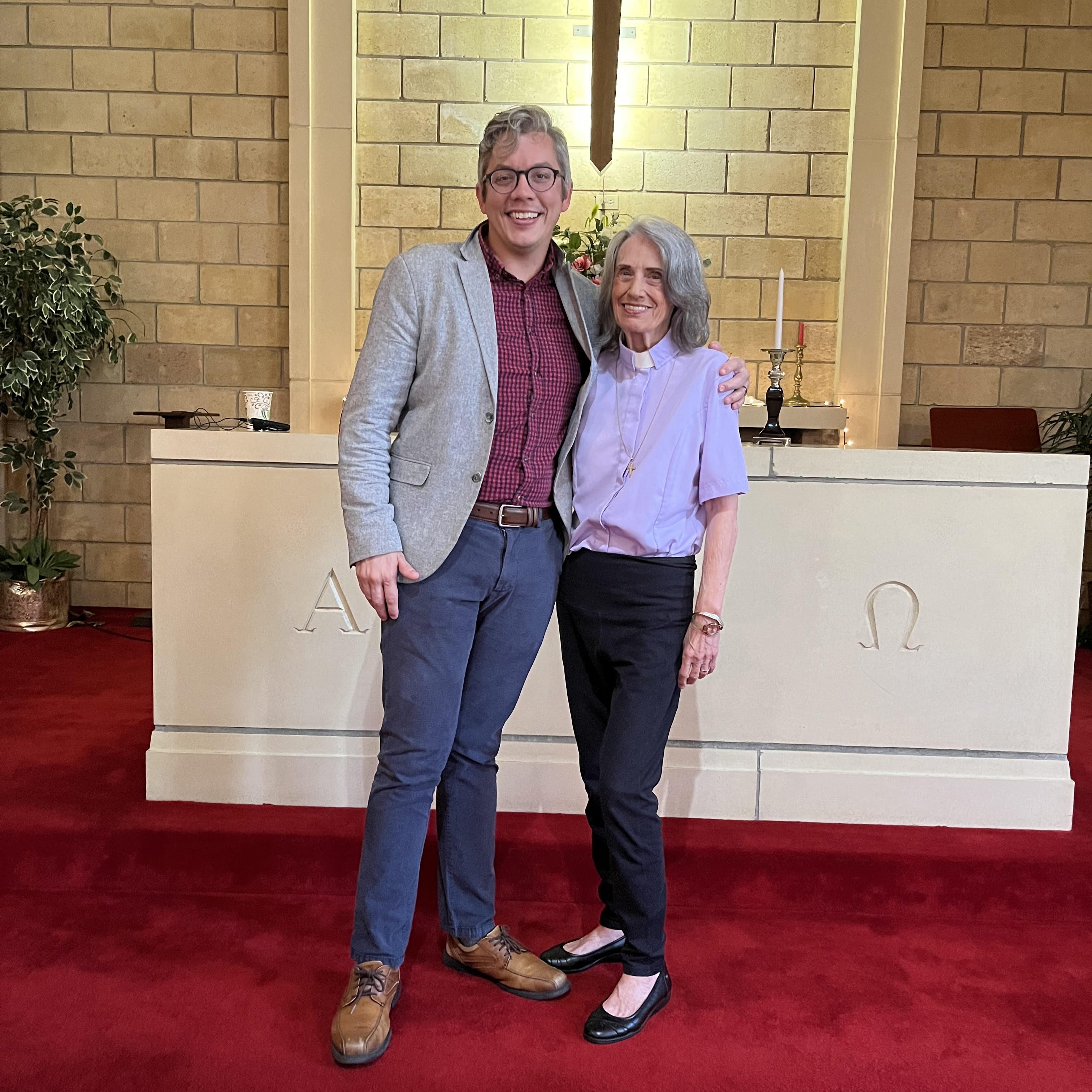
Today’s sermon title is The Gospel according to DEI, which stands for Diversity, Equity, and Inclusion. I work in this field, doing Interfaith in a DEI framework. And as I shared with you in July, this field has become a political football, in Florida and other states. Hostile legislators and governors have declared war on it, which usually is a thinly veiled attack on Black people, women and LGBTQ people. Meanwhile, there is a legitimate debate in other more reputable forums about whether DEI goes too far or not far enough. Sometimes, in the corporate world and higher ed, DEI trainings are accused of having no teeth. Other times, DEI becomes a point of conflict with academic freedom. Do social justice warriors go too far?
This sermon will be too short to define the field and all of its controversies. But they are all on my mind, as I struggle both to keep my job and to offer my own perspective. As I have reflected on how I arrived at my place in all this, I couldn’t help but notice that one way I answer it is: for the Bible tells me so.
I think the Bible has something to say about how we value diversity, work for the justice of equity, and achieve the beauty of inclusion. I think I have been reading and seeing it in the Bible from my earliest memories. And as I reviewed today’s lectionary readings, I was struck by how they all address some of the more controversial concepts of DEI: power, privilege, and oppression. Should we talk about systemic injustice and who does it to others and hold them accountable? How do we even compare these modern concepts to an ancient scripture?
Because the Bible IS an old book. I’m not just talking about your 1990s NIV Adventure Bible gifted to you in 4th grade, you know the one with the cover ripped off years ago but you still keep it for nostalgia. It’s not even the dusty, yellowed King James Bible inherited from your great, great grandparents, a crusty heirloom with pages falling out and crumbling to dust. The Bible is a book put together thousands of years ago. With ancient stories in it that crawl back even further to 3000, 4000 or more years ago. Echoes of millenia that we can hold in our hands.
Or can we? The Bible you hold in your hands is in English, but it is a translation and interpretation from Ancient Koine Greek and Hebrew and even some Aramaic. And those words you see there, sometimes they are guesses. In ancient Hebrew, the vowels were not in the writing, so there is some guesswork and interpretation involved. Other times a word could go several ways. In Greek, camel and rope are very close in writing. So does Jesus say it’s easier for a camel or a rope to go through the eye of a needle than a rich person to enter the kingdom of God? Or sometimes a missing word creates a brand new, completely opposite meaning, as in what became known as the Wicked Bible, which omitted the word “not” and thus commanded people, Thou Shalt Commit Adultery.
That one might be easier to figure out, but much of the rest of the Bible can be quite a puzzle. And we haven’t even considered the compositional and historical questions: how did these stories come to be recorded? Who passed them on? Who told them orally and who wrote them down? What fragments do we use to reconstruct passages? What role did memory and theology play in creatively reimagining a scripture which goes beyond strictly historical facts? In other words, How do we apply this book, this approximation of ancient memories, to our modern context, far removed in culture and time?
Maybe I have overstated the problem a bit to start us out on the ground of humility. Humility is always a good place to start in interpretation. Even when we know much.
And, it’s true, despite the challenges, thanks to generations of scholars, there is much we understand about the stories of the Hebrew Bible and Christian scriptures. Sometimes that is the problem itself – we understand and it bothers us. For better or worse, it bothers us, it sticks with us. The good, the bad and the ugly of scripture. There is something human in there. And for a lot of us, there is something divine in there that has a hold on us. That is faith. Not something entirely our own choice. Something which has chosen us, but also that we choose to leap for. There is something human in continually reinterpreting this ancient holiness. We see it in the scriptures themselves, they speak to the evolution in interpretations which we continue to live.
The book of Exodus provides us a case study in this matter in our reading today. One of the most famous and central stories of the Hebrew Scriptures, of God delivering the people of Israel from bondage in Egypt across the parted Red Sea. Or was it the reed sea, a completely different and more passable body of water? Difficult to translate words strike again. Some would seize on a scientific question: is there a way a wind could have blown and caused this to happen naturally? We could also consider the historical record and whether this is more of a mythical story.
But if we hold those concerns lightly, and our different interpretations, we may turn together to a question of meaning. And this is where a passage like this has stirred and bothered people of faith for generations. This is a story of delivery which not only buoyed the Jewish people through millenia of travels and travails, of persecutions and perseverance, but a story which we Christians and others adopted. Jesus as a new Moses. Moses as a prophet in Islam. Millenia later, enslaved African Americans found courage in the story and heroic deliverers like Harriet Tubman were called the Moses of their people.
Thus the Lord saved Israel that day from the Egyptians. Saved from their enslavers. Saved from their oppressors.
The writers of Exodus are not shy about who the enemy is. Or about what God does to the enemy. The Lord tossed Pharaoh’s army into the sea.
There is no hesitation to name who did what to who. Harriet Tubman did not deliver her people from a generalized enslavement. She delivered her people from White Christian Southern enslavers, who were fighting a war to preserve their enslavement and doing it in the name of Christ. That’s history, it’s the history that has always bothered people so much they wanted to hide it and call slavery a job skills program or say that Rosa Parks stayed in her seat but we’re not going to say who demanded she move based on laws we are not going to call racist. That’s Pharaoh writing history.
But when God writes history, the oppressor is named. And the oppressor is opposed. And the oppressor is defeated.
Miracles of justice are not always so neat in our world. But we can be sure of this much: the first step to overcoming oppression is: naming it.
It’s not just Exodus which is unafraid of naming oppression. The later Hebrew prophets rail against the rich and powerful for their economic exploitation of the poor and vulnerable. Their rallying cry is justice, which, again, is not a generalized improvement of life. It is a correction of injustice enacted by those with power who should know and do better.
And this is how Jesus’ ministry is from its start. In his first sermon, he quotes the prophets, saying, I have come to release the captives, to bring good news to the poor, and to let the oppressed go free.
The good news, the Gospel includes freedom overcoming oppression. I can imagine people saying, This Jesus focuses too much on oppression. He should focus on the positives.
You won’t be the most popular person or biggest fundraiser by naming oppression.
Sometimes you can feel a bit like Debbie Downer. Do you know this Saturday Night Live skit? You see Debbie always know how to bring things down. She and her friends go to Disney World and they’re so excited to be in the most magical place on earth, and Debbie says something like, well, it’s also the place most likely place to contract a deadly airborne virus. They share the rides they’re excited to go on, Space Mountain, Haunted Mansion, Thunder Mountain Railcars, and Debbie says, Did you guys here about that train wreck in northern France? We never know how many died. They see Goofy and rush to get pictures with him and Debbie says, with that costume on, he must be in the early stages of heat stroke. Her theme song goes like this: You’re enjoying your day, everything’s going your way, and then along comes Debbie Downer, always there to tell you about a new disease, a car accident or killer bees, You’ll beg her to spare you, Debbie please, but you can’t stop Debbie Downer.”
And throughout this skit, they are all breaking, bursting out into laughter, unable to keep a straight face. It’s comedy gold, but I also think there is this element of – we can’t look bad news straight in the eye. Sure there are some people who seem to focus excessively on the negative. But we laugh, we make light of, we make fun of those who tell us the bad news in part when we can’t bear to face it. When it would challenge our comfort, even our power and privilege. And so we say stuff like, we need less critics in the world.
But Jesus never stopped speaking truth to power. Comfortable and powerful and rich people were annoyed by him. I am sure people called him a Debbie Downer. I am sure they laughed because they did not know how to face his critique of systemic injustice.
Being a critic does not mean you can’t also be constructive. Jesus called people out who abused their privilege but he also called people in who were willing to reinvest their power and wealth by giving it away. Zacchaeus joins Jesus, giving half his fortune away and offering reparations from those he defrauded, offering 4 times what he took. Jesus invites the rich young man to give away his wealth to the poor, but he walks away, and Jesus has compassion for this young man who could part with his power and privilege.
Even in our Gospel reading today from Matthew 18, Jesus has some peculiar insights about power. This is a passage which on its face is about forgiveness, about extravagant forgiveness. Forgive how many times? Seven times? No, seventy seven times, Jesus says. No doubt about it, Jesus is big on forgiveness.
This teaching might trouble us for several reasons. One is that forgiveness is hard. Just as Jesus is willing to make people uncomfortable by naming oppression, Jesus is willing to make people uncomfortable by saying, be reconciled with each other. Don’t remain enemies. In fact, of course, Jesus says, Love your enemy.
But this teaching can also be troubling because it is too often used by humans to demand forgiveness of victims. You must forgive because our Father says so. The abused, the oppressed should let it go, and forgive their oppressors. Why talk about oppression? Just forgive and focus on the positives.
Writer Ta’Nehisi Coates puts it like this with regard to racism: “Indeed, in America there is a strange and powerful belief that if you stab a black person 10 times, the bleeding stops and the healing begins the moment the assailant drops the knife. We believe white dominance to be a fact of the inert past, a delinquent debt that can be made to disappear if only we don’t look.”
Likewise, if someone stabs you seventy seven times, should you forgive them each time? Is that what Jesus is teaching here?
Context matters. Note that Jesus and Peter are talking about the church. It’s odd because the church didn’t exist yet, so perhaps this is the church speaking to itself, remembering a teaching of Jesus on forgiveness and making it for their context. Which is, a group of people, a community, committed to one another, committed to following the way of Jesus, the way of compassion, who nonetheless fall short and sin against each other. And we know, because we know the church, that that can be some petty BS, and sometimes significant harm. And there are other teachings about accountability in the church, which this forgiveness teaching cannot be separated from. All of that to say, Jesus is not teaching us to forgive unrepentant abusers or societal oppressors.
And if you’re not sure, then let’s look at this parable. It’s about a king and his slaves, essentially his indentured servants. They are bound to go out to collect tribute to the king, and when they fail, they can’t pay their debt. So we meet a slave who begs for forgiveness of his massive debt. The king forgives it. And then the slave goes out, finds another like him who owes him, and his countenance changes, he accosts the man, and demands “Pay what you owe!”
What is peculiar and notable about this example of a failure of forgiveness is that Jesus does not tell us a story of a victim not forgiving their attacker. He tells us a story of someone lording their power over others. He’s saying, don’t punch down when you should be forgiving. He’s saying to the church, who are even ground with each other as believers, neither Jew nor Greek, male nor female, not to hold power over each other. That is an odd way to teach forgiveness. Unless you’re a person who understands power dynamics, who wants to teach forgiveness but not abuse and oppression, who is always concerned with how we treat the vulnerable.
And that’s who Jesus was. He just wouldn’t shut up about this. He could hold together the possibility of naming oppression, of teaching power dynamics, but also opening the holy possibility of the kingdom of God, where oppression ceases, where everyone can be included, and where the world can be reconciled.
It’s a wonder and also no wonder that Jesus came to this understanding, because God had been speaking it through the ages, through his people, the people of Israel and their scriptures. I wonder how well he knew this final scripture reading we heard today, from Genesis 50, of Joseph and his brothers.
It crystallizes everything we have spoken about today. Joseph was a son of Jacob, renamed Israel, the father of his people, and Joseph the privileged son. He didn’t have the privilege of being firstborn, but he did have the privilege of being his Father’s favorite son. And so he was given his coat of many colors, aka his Amazing Technicolor Dreamcoat.
Have you seen this musical? I have, because I’m the son of a music teacher. So I’ve seen most of the musicals. In this movie version, Donny Osmond played a fairly old looking teenage Joseph. This is an Andrew Lloyd Webber musical, so it is big and fabulous and garish and melodramatic.
It makes it a little easier to stomach what Joseph’s brothers do to him. His sin is being a bit bigheaded, so his brother conspire to kill him. They waver and decided instead to take his coat and throw him into a pit. He’s later found in the pit by traders and sold into slavery.
And his brother’s dare ask in our passage today, “What if Joseph still bears a grudge against us?”
In the intervening years, Joseph’s fortune has risen and fallen, eventually landing him in an Egyptian jail, where word comes down to him that Pharaoh’s is being troubled by dreams he cannot interpret. But Joseph can. And so, the boy, cast into a pit and slavery, falsely accused and jailed, rises to unforeseen power and becomes the advisor of the Pharaoh.
So his brothers are correct to fear his power over them, and their response is to go right back to their old ways. They try to assert their power over him. This is no good faith bid for forgiveness, this is the manipulation of older brothers in a patriarchal society. They say, you must forgive because our Father says so.
Its classic manipulation of the oppressed by the oppressor. Wonder why still bear a grudge. “Why won’t you just let it go? Stop being such a victim.” Demand forgiveness. Avoid accountability. Gaslight the harm you caused.
There are two obvious ways for Joseph to respond. One is to passively accept. The other is to seek vengeance.
Instead, Joseph utters these telling words: “Do not be afraid!”
He then says, I am not God, but you know what? He sure sounds like it in that moment. Angels say, do not be afraid. Jesus says, do not be afraid.
Joseph, in that moment, speaks to the humanity of his brothers. And pay close attention: he does so without accepting their forgiveness.
He does not even acknowledge their manipulation; leave our father out of this, he seems to imply. Instead, he points higher: you intended harm, but our Father in heaven can make good out of even that. He sees God’s plan at work for good.
And so he tells his brothers. Have no fear, I will take care of you and your little ones.
Joseph, in his new place of power seeks not vengeance, nor does he bow to his brother’s power play, but he uses his privilege to transform the relationship of oppressed to oppressor.
He does not simply let his brothers off the hook, but he offers then a new way to be human.
Naming oppression and claiming forgiveness. Joining together to end injustice, and make a more just world for all.
That is good news. Kingdom come on earth as it is in heaven.
This is the hope of the gospel, and in many ways, it is the common cause that the gospel has with diversity, equity, and inclusion work. A world that overcomes oppression and includes all. For the Bible tells me so.
 Matt Hartley