Sermon: Joy and Weeping
Southside Christian Church, Jacksonville, Florida
April 6, 2025
Scripture: John 12:1-8
We live lives of joy and weeping. There are times when we laugh more, and times when we cry more. And there are many times when we can’t seem to separate the joy and weeping. When we must hold one and be reminded by the other. We live in a world of great beauty and great tragedy at all times. There is only so much of that we can hold – we were not meant, for instance, to constantly watch 24 hour news or doom scroll social media all day. One thing we need to do is switch off the TV or log off of social media. But the point is not to avoid the pain and tragedy of the world. The point is not that we are never outraged. The point is to pay more attention to our lives, to those who are with us, and indeed to Christ, who is in the room with us as he was with Mary and the disciples in our reading today, six days before his death. The point is to be like Mary, the woman who showed faithfulness.
Death bookends this story, as it bookends moments of joy in our lives. Behind Mary was the death of her brother, Lazarus, his return to life courtesy of Jesus’s miracle still tinged by the trauma and grief. And perhaps the lingering knowledge – death could not fully claim Lazarus that day, but one day it would. We are mortal. We face death, sometimes in our own bodies, sometimes in losing those closest to us.
Perhaps this allowed Mary to see what was coming for Jesus. She knew who he was, she knew the controversy he caused. One gets the idea that this Mary, alongside the other Marys including Jesus’ mother and Mary Magdalene, was quicked on the uptake then the men, Jesus’ disciples, who often seemed thick headed, distracted, and often missing the point. So it is that Judas presents the extreme example of this in our reading today – worried about the money, for his own sake really though he pretends it is for the sake of others.
But Mary knows. This moment is important. Time is short. Joy and weeping meet as Mary wipes Jesus’s feet with costly perfume, a mesmerizing act of intimate care and love, of steadfastness, of faithfulness. She anoints him for burial.
There are things incredibly important to notice in the faithfulness of women. Of course, it is good to be careful about presenting gender differences as objective realities. The old book title goes: Men are from Mars and Women are from Venus. Or boys goes to Jupiter to get more stupider. Men are pigs or women are catty. Women are bad at driving or math, and men are emotionally stunted. None of these stereotypes is objective truth. They put us in gender traps, when our identities can be much more whole, dynamic, and unique, without reference to gender. And our faith says it: in Christ, there is neither male nor female.
But before we arrive at any of that, we must confront the world as it really is. There is a way that women are expected to be. There is a place women are put in. And there are roles women play – all of this giving them a unique perspective. So often treated as less than, so often in history and even today under the subtle or very obvious demands of patriarchy, women tend where men rage, women care while men clamber for power. Women often know the intimacy of parenting more closely than men as well. We should pay attention to the loving, the tending, the steadfastness of women.
Is it any wonder that, despite not being afforded the honor of being named disciples, women are on the scene first through so much of the Gospel. Mary mother of Jesus is the first to carry the Word, in her very womb, after responding with faithfulness to God’s plan. At the end, Mary Magdalene will be the first to visit Jesus’ tomb, meet the risen Lord, and share the good news. And in our reading today, Mary, sister of Lazarus, anoints Jesus’ feet, days before Jesus will do the same for his disciples. Is it possible that Jesus learned that he wanted to wash his disciples’ feet through Mary’s example?
I know I am preaching to the choir here. This church has known the faithfulness of women, who fill the pulpit, despite those out in the Christian world who say women should be silent. This church has known the faithfulness of women who keep the church running, as so many churches have known even where they deny women places of formal leadership.
I’m thinking of my own mother and grandmother, a church pianist and a church librarian. I’m thinking of Dr. Fran Louwerse, an elder in the church I grew up in, who when I was a teenager, invited me into leadership in the church. I’m thinking of my friends Rev. Rachael McNeal and Deacon Catherine Montgomery, who preach on Sunday mornings. I’m thinking of Rev. Dr. Yolanda Pierce, a seminary Dean who writes about faith from the frame of her grandmother and all the matriarchs of the Black church, of whom she writes: “”In a world eager to promote the newest wunderkind, grandmother theology carries us two or more generations back: to the kitchens, hair salons, gardens, and church basements of older Black women who are often invisible in theological discourse but without whom the American Christian church would cease to exist.””
___
And I am thinking of the women who now live where Mary of Bethany lived. For 500 years, the village has been known by another name – al-Eizariya, Arabic for Lazarus. Today’s residents are Palestinians. And the women of Palestine are weeping – weeping that has gone on for 76 years and only grown greater as Gaza has been destroyed over the last 18 months. Women in the West Bank, where al-Eizariya is located, have kept families and communities together and led resistance to oppression while many men have been jailed or exiled. Yet, they still take joy in their people, their culture, their land.
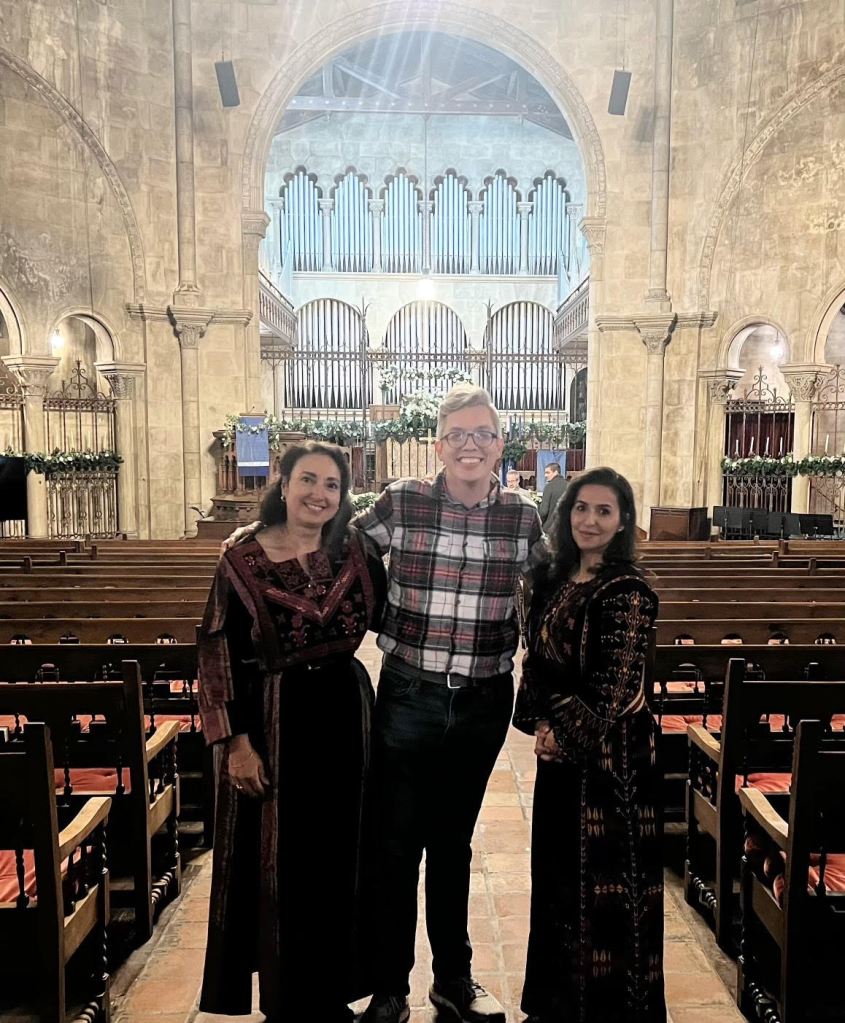
In our own city, I have two close friends who are Palestinian women. I witnessed them hold joy and weeping together. One is actually named Joy. She is a Palestinian Christian, born and raised in the US. Her family is from Ramallah in the West Bank. She has proudly represented her people for decades, around the city, and to our elected representatives. Holding joy and weeping together may seem impractical sometimes; it is hard to see progress, but it is how she shows love and steadfastness for her own sons and her own people. In Arabic, this is known by the word Sumud. And while Joy’s Sumud may start with her own people, she is one of the biggest hearted people I know. Her love for her Palestinian siblings is not the limit, but rather the root of her love for others. Or more accurately, the root is actually the love that extends to all people, the love of God.
My other close Palestinian friend is Ranna. Ranna means to gaze, mesmerized, as if full of love. The name reminds me of how Mary looks on Jesus in this moment before tragedy, and this is exactly how my friend Ranna looks on her land and her people.
And so as the children of Gaza have suffered over the last couple of years, she has helped bring children to Jacksonville to receive medical treatment. Several children have come to our medical facilities with injuries that they sustained in bombings and war, and they have been loved by our community and Ranna has been leading our community and showing that love for these children. And we had a Gala for this organization a couple of weeks ago and they brought up Mohammed, one of the children; part of his skull was blown off. And so he came to Jacksonville to have part of his skull repaired but he was well enough to come on stage at the Gala and they had a musician come up with a drum and he beat on the drum and danced with Muhammad and his mother, they’re dancing on stage with 200 people in this room dancing together. And there’s such suffering there, but there was also such joy there. You could see how the joy and the weeping were held together.
As I honor the women in my life who have taught me so much about faithfulness, I honor Joy and Ranna. They have shown me that holding joy and weeping together is an extravagant act of love for God’s children in Palestine but also wherever they live, especially where they live under oppression and war, where death surrounds, but faithfulness abides. This is what Mary teaches us today as Jesus faces his death.
—-
In the end, Mary of Bethany’s lesson is not just for one people or one gender, but an invitation to all of us to be in the struggle of each others’ lives together. We should be clear about what Mary is doing for Jesus here. She is anointing him with a pound of rich perfume, which was indeed expensive. Whether we can trust Judas’s assertion that it would go for 300 denarii, which was close to a year’s wages for a common person, is questionable. Perhaps he was exaggerating. We’ll get to his reasons in a moment. But this much is true: Mary spent wastefully on Jesus.
We should be clear though. This is not Mary buying Jesus a second vacation home. This is Mary anointing Jesus for burial. This is not about Mary spoiling Jesus with some kind of luxury. It is about her tending to him in a moment of great stress and struggle, when he can see the end of his life coming. It is like the hard end of life choices, whether to put a loved one in hospice care, or when we choose a casket or different burial method for a loved one – finances may be a concern but really want to give the best to our loved one. Mary’s economy in this moment is an economy of love.
Judas, on the other hand, has a different doctrine. We could call it a Doctrine of Gospel Efficiency. The narrator tells us he doesn’t actually care about efficiency. He just pretends, while he steals from everyone. But it’s interesting: Jesus responds not to the corruption but to the sincere argument: shouldn’t we spend this money on the poor?
Jesus responds by quoting scripture, from Deuteronomy, a passage about helping the poor. And in fact, scholars speculate that ancient Bethany was a haven for the poor, that it had an almshouse, which is why Jesus may have ended up here so much. It is entirely possible that Lazarus, Martha, and Mary were supporters of this almshouse themselves.
If this is the case, then Jesus’s response means something like this: we have helped the poor before and we will keep helping the poor. It is who we are. But now, in this moment, Mary has tended to my life with love, as I face this terrible moment.
There are many problems in the world. There is much work to do. But we each struggle too, and we each need Marys who will tend to us with love. We each need to be Marys who will tend to each other with love.
Judas is limited by his greed. But Mary, Mary knows. Mary loves in the face of suffering and death. Mary has no scarcity of love. She can hold joy and weeping together. Amen.
 Matt Hartley